A properly-costed guide price
Priced from your architect's drawings before you commit. Not a headline number to win the job — an itemised guide, broken out by trade and material, that you can audit.
The model
Open-book, in plain English. What it is, how it works, and the questions homeowners ask before they commit.
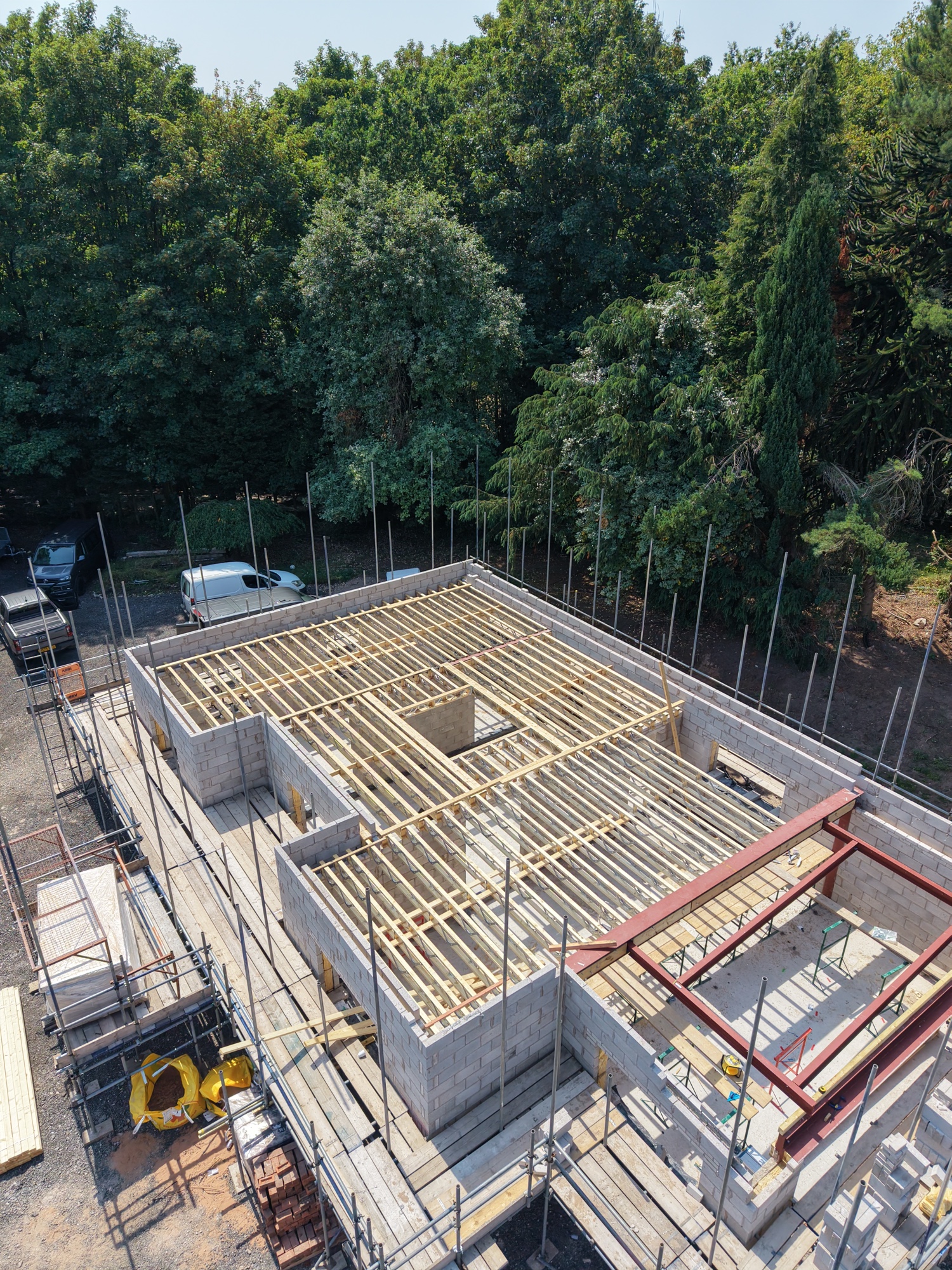
A live Built Clear build — first-floor joists in, structural steel dressed, scaffold ready for the next lift. Every invoice on the job visible to the client on Buildertrend.
Two ways to price a build
There are, broadly, two ways a builder can price your project. Neither is dishonest. They just carry different economics — and the difference matters.
| Fixed-price | Open-book (how Built Clear works) |
|---|---|
| A single lump-sum quote agreed before work starts. | A guide price agreed up front, then real costs as they land. |
| The builder takes on the risk of anything unknown. To do that safely, most quotes build in a risk premium. | Real costs pass through at cost, plus a flat 10%. No risk premium is needed. |
| Profit sits inside the price. You don't usually see how it breaks down. | Every merchant invoice and subcontractor invoice is in your project file. Every pound is visible. |
| Variations become a negotiation — a change costs whatever the builder decides. | Variations are a decision. You get the real cost, plus 10%, in writing, before we do it. |
| If the job comes in under, the builder keeps the difference. If it goes over, the conversation gets harder. | If it comes in under, you pay less. If it comes in over, you see the invoice for why. |
Fixed-price works well for very small, very well-defined jobs. Open-book works better once there's any real uncertainty — which is almost every renovation, extension or conversion.
What open-book actually means at Built Clear
Priced from your architect's drawings before you commit. Not a headline number to win the job — an itemised guide, broken out by trade and material, that you can audit.
Agreed on day one and written into your terms. Covers me running your project — programme, procurement, site management, subcontractors, building control, snagging. It doesn't move if the site is slower or faster than planned. The only thing that changes it is a real change of scope — new work you've added — and any adjustment is agreed openly with you first.
Every merchant invoice and every subcontractor invoice is uploaded to your build file exactly as I received it, and passed to you at cost. Built Clear adds one flat line on top: 10% for overheads and profit. That's it.
And because I've been buying through the same merchants for years, my trade accounts carry favourable discounts a homeowner or a smaller builder wouldn't get. Those discounts come off the top of the invoice before it reaches you — the saving sits with you, not with me. Multiply that across every material and every trade, right through to the last snag, and it adds up.
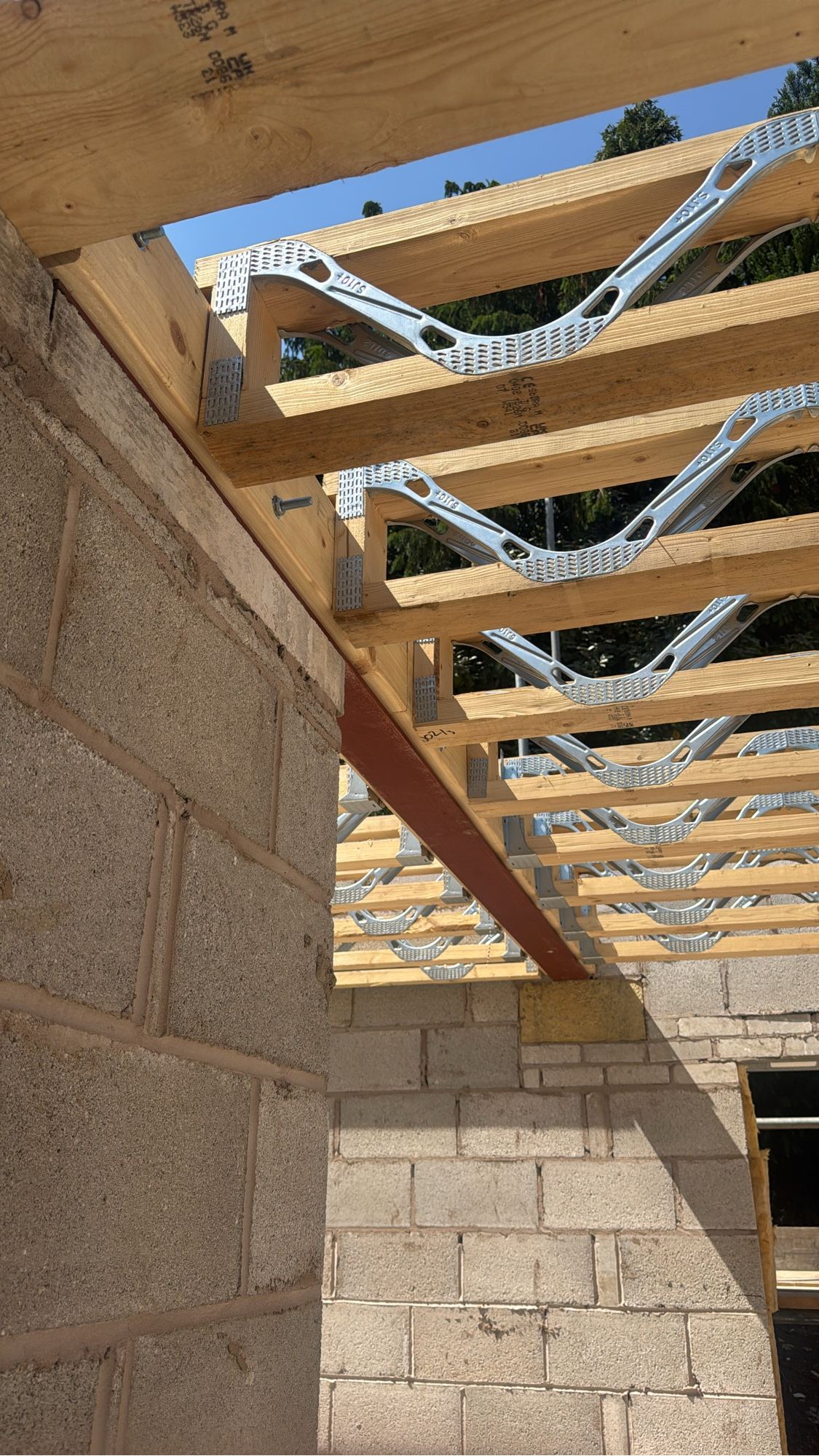
Engineered joists, web plates, structural steel. Every one of these components arrived on an invoice you'd see, at cost plus a flat 10%.
Why my incentives line up with yours
The management fee is agreed on day one. It doesn't grow if the job drags on. The only thing that changes it is a real change of scope — new work you've asked for that wasn't in the original plan — and that adjustment is agreed with you in writing before we start the extra work.
That matters, because under a percentage-based model, a longer job earns the builder more. Under mine, it doesn't. If we agree a 20-week programme and finish in 18, I'm onto my next project two weeks earlier. If we drag to week 24, I've earned nothing extra for those four weeks while my next client waits.
The incentive is simple: run it properly, finish on or ahead of time, move on. Same incentive you have.
Building a house involves more than just the direct cost of the materials and labour. There's overhead, profit, preliminaries (site management and insurance) and project management to cover on top.
Industry data suggests that when you combine these, a traditional residential builder typically loads 25 to 40% on your direct cost — overhead and profit alone running 15 to 33% (Association of Professional Builders 2024 survey of 1,800 firms), plus preliminaries of another 5 to 15% (Procore UK).
A further factor most homeowners don't see is buying power. A well-run building business earns better trade rates on materials than a homeowner or a smaller outfit can access — sometimes materially better. Under fixed-price contracting, those discounts stay with the builder. Under open-book, they come off the invoice before it reaches you.
That loading is normal, and it's how most builders have to price to survive. What's different about Built Clear isn't that the loading is dramatically lower — it's that every part of it is on the invoice you can point at.
| Cost loading | Traditional fixed-price | Built Clear |
|---|---|---|
| Overhead and profit | 15 to 25% on cost, inside the price | 10% on cost, on a line of its own |
| Preliminaries (site management, insurance) | 5 to 15% on contract value, inside the price | Included in the fixed management fee |
| Project management | Often inside the price | Included in the fixed management fee |
| Total loading on cost | Typically 25 to 40%, largely invisible | Typically 20 to 25%, every pound visible |
You may pay less. You may pay similar. What you definitely get is the ability to see exactly what you're paying for.

Same open-book model, from the first invoice to the last. What sits on the drive is the payoff for keeping the book open the whole way.
The four questions homeowners ask
Usually the opposite. A fixed-price quote has to include a risk premium — the builder is taking on the unknown, and pricing accordingly. Open-book doesn't need that premium, because the actual numbers flow through as they happen. On like-for-like scopes, a Built Clear guide price usually sits at or below the middle of the fixed-price tenders, and there are no variations built up over the job.
Because you can see them. Every merchant invoice comes from the merchant on their letterhead. Every subcontractor invoice comes from the subcontractor. Both sit in your build file on Buildertrend. If you ever want to phone a supplier or a subcontractor to check a rate, you can — and I'll happily give you their number. The 10% is the only line I add.
The guide price is built from your architect's drawings before the ground is opened up. If real costs come in lower, you pay less. If a genuine unknown surfaces once we're on site — a rotten joist, a poor foundation, an asbestos find — you'll see the actual invoice for putting it right, at cost, plus 10%. Because there's no fixed price to defend, there's no reason for the conversation to be difficult.
You can, and you probably will — most people do once they see the house taking shape. Changes are a decision, not a negotiation. You get the real cost of the change, plus 10%, in writing, before we do it. Add a rooflight. Upgrade the flooring. Extend the utility. It's your house.
A worked example
Say we're demolishing an existing outbuilding as part of your project.
Under a fixed-price contract
The builder quotes a single figure — let's call it £10,000. They have to include a margin for the risk that once demolition starts, something behind the wall makes it harder than it looked.
If the job costs the builder £4,000, the £10,000 stays as £10,000. If it costs £14,000, there's a difficult conversation about a variation. That risk transfer is why fixed-price works the way it does.
Under Built Clear open-book
The demolition happens and the invoice comes in for whatever the actual work cost — say £4,400 or £13,200 or whatever the honest number is. That invoice sits in your file. You pay the invoice plus 10%.
If it runs quicker or cheaper, you keep the saving. If it runs harder or more expensive, you see exactly why and what it cost. There's no incentive on my side to pad a line, because I don't keep the padding.
That's the mechanism. It applies to every trade, every material, every day of the build.
"You should never have to wonder where your money is going. With Built Clear, the book is always open."
— Benjamin Parry, Director
What you get in practice
Further reading
The government just announced a crackdown on cowboy builders. Read what the new Approved Code and Trusted Payments schemes mean for homeowners →
Want to see it applied to your project?
Extensions, whole-house renovations, barn conversions, new builds — anywhere in Chester, Cheshire or North Wales. Usually a same-day reply.